Research on the Camp d'Elx in the pages of El Setiet
14-08-2020
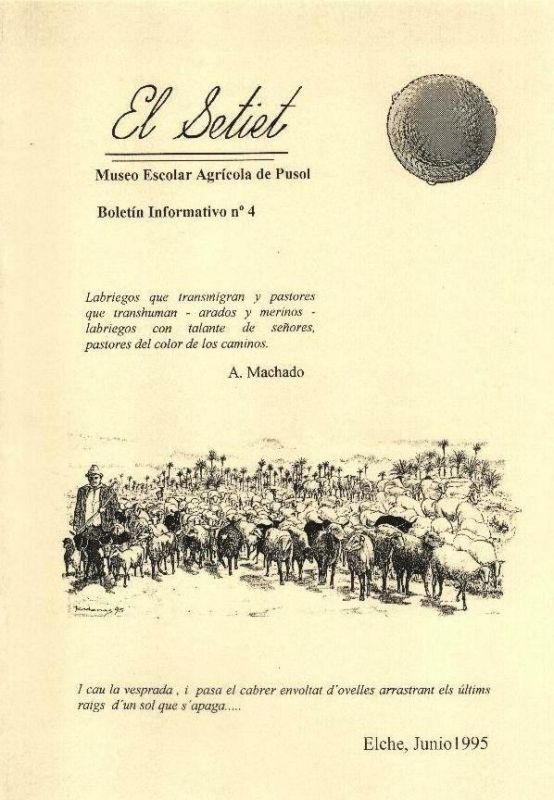
In October 1993, the museum began publishing El Setiet. The year after our official recognition, the publication of a magazine meant a qualitative leap in the activity carried out in Puçol, which from now on would reach greater diffusion and popularity. The Setiet, "round piece, more or less flat, made of esparto, sometimes mixed with cisca and almasset, and sewn with palm", became a symbol for us and, since then, his drawing will always appear on the cover of our newsletter. As you know, all the issues published to date -25- are available on this website.
The Setiet is an informative magazine that gathers news and articles about our activities. It presents a small number of sections, which includes a wide range of topics that, among others, are of interest to history, anthropology, education or heritage, also focusing on those aspects related to everyday life in our school. All this is tackled with an agile approach that is reinforced by the vividness of the opinions and testimonies included in its pages.
Along with varied and profusely illustrated contents, El Setiet incorporates a simple format that combines aesthetics and amenity: attractive format in Din A4, use of ahuesado editorial paper or use of large characters, are characteristics that help explain the popularity achieved by our magazine.
Among the topics discussed, we highlight those related to the Campo de Elche, as ancient works, customs or traditions; typical clothing and gastronomy; folklore, beliefs... Ethnographic research will not take a nature chart in El Setiet until the appearance of numbers dedicated to the missing crafts. In 1996 (No 6), the publication of an extensive dossier on hemp marked a turning point, both in the publication itself and in the museum’s dissemination career. From now on, the pages of El Setiet will not only host short informative texts, but they will give way to the research carried out by the team of collaborators of the center. The combination between, on the one hand, the exhaustive information provided by retirees/ environment, direct and agile; and, on the other, the excellent drawings that - following his indications - illustrated it, all together with a final glossary, was the beginning of a new stage in the magazine.
Two years later, under the generic title of La Trilla (nº 8, 1998), a lengthy study was published not only of this task of the rural calendar, but of the material culture present in the whole cereal process, from cultivation to bread making. Over seventy-six pages, this monograph was probably the most ambitious work published in El Setiet, presented with amenity, beauty and rigour.
In 1999 (No 10), the magazine was dedicated to one of the most significant works around the manufacture of espadrilles. The description of the sewing of the hemp sole introduced us to the immediate antecedent of the current footwear industry of the city, the hand of a former professional fallen into oblivion: the seamstress. The vindication of his figure came to follow, in a certain way, what was said years ago about hemp in the pages of El Setiet.
Finally, in 2001 (No 12), one of the first research works carried out by school children, years ago, was published: The palm tree: classroom work, which included an exhaustive description of the tasks associated with its cultivation, described with the spontaneity of children/s. For the first time, the magazine published a facsimile and brought to light, in full, one of the first studies of the school/s.
Throughout its long career, El Setiet will collect other monographs dedicated to themes such as funeral customs (to which Nº 16, 19 and 20 will be dedicated from 2005); the monkey (Nº 17, 2006) or, on the other hand, the great expansion of the museum that took place between 1999 and 2001 (nº 8, 2008), all of which will be discussed later in this blog.