History of a bicycle
12-01-2021
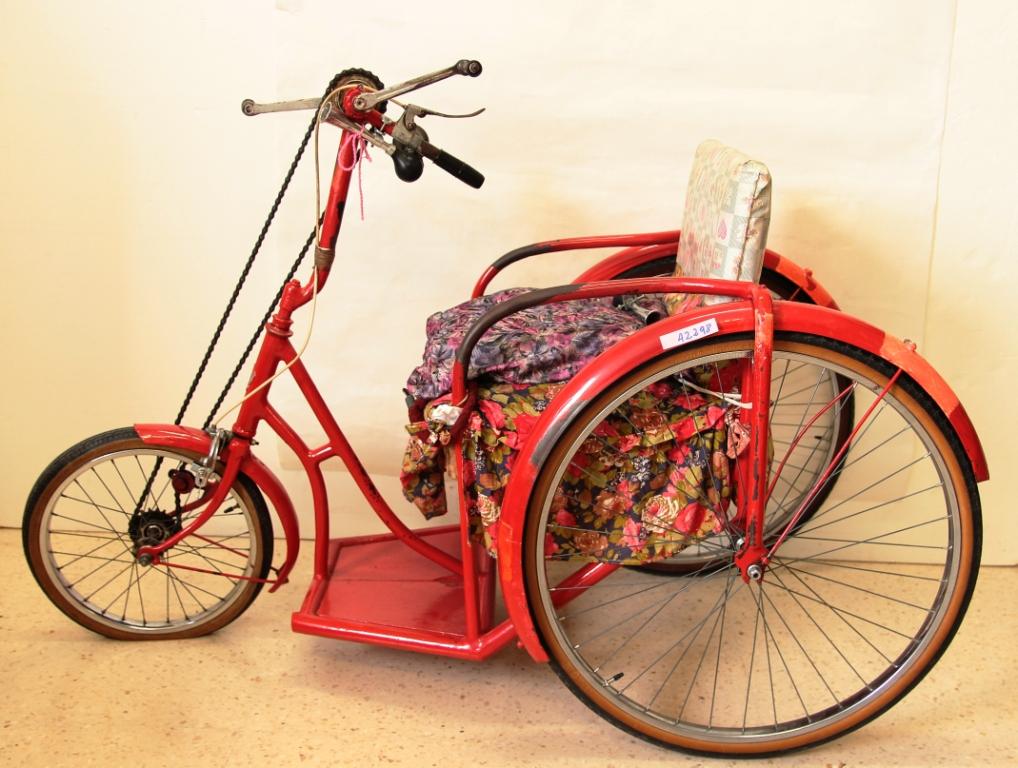
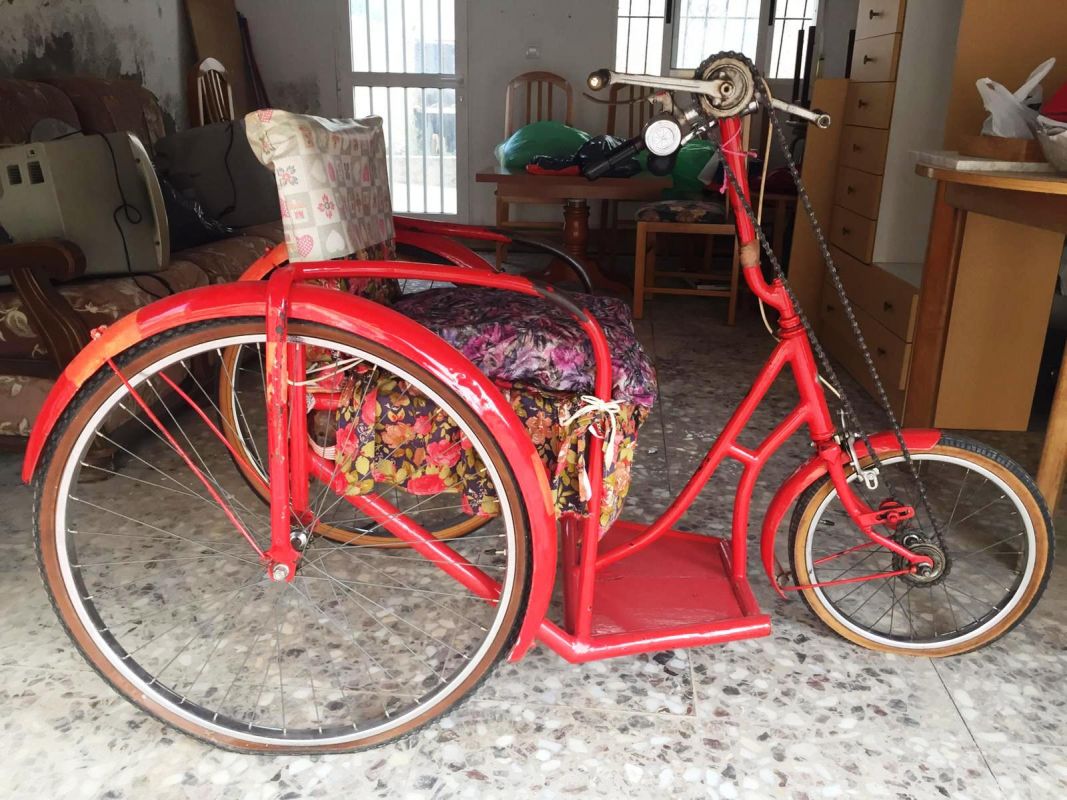
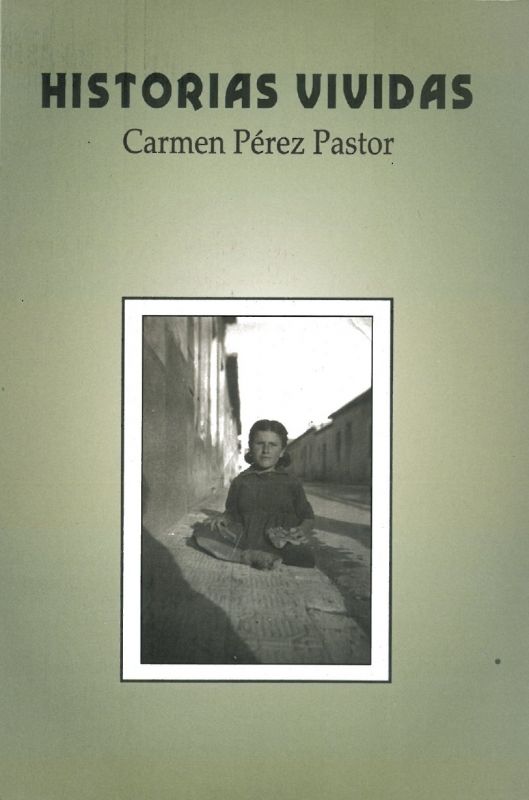
Few months ago, thanks to the good work of Virginia Navarro, of the Elche Town Council, it got in touch with us, Adoración Aliaga, President of the Christian Fraternity of Persons with Disabled (association known as Fráter), who offered to donate to the Museum an old manual bicycle, It was of a bicycle adapted that had belonged to Carmen Pérez, neighbor of the nearby town of San Miguel de Salinas. When we went to this municipality of Bajo Segura to pick up the piece, we found that, along with her, "la Fráter" also made us a donation of Carmen’s memories, a simple and sincere book, through whose pages her author breaks his life, next to that of his people.
Historias Vividas is an interesting work and, of course, recommendable; first of all, to meet Carmen, a good woman, tenacious fighter and tireless worker. But, in addition, the reading of its pages also leads us to discover, on the one hand, the changes experienced in the municipality of San Miguel de Salinas throughout the twentieth century; and, on the other, to know "la Fráter"organization, fundamental in both the life of Carmen and that of other people with disabilities. In this short text I will refer to those chapters in which the author tells us about her childhood and youth, the hardest years of the postwar period, which Carmen describes through her memories, showing us a people as distant in time as present even in the memory of the elderly. In a succinct way, we will also echo the close link that Carmen always maintained with "la Fráter", a fact that will prove decisive in her life. "My name is Carmen and this is my story," he begins by telling us...
Carmen Pérez Pastor was born in 1935 in San Miguel de Salinas, a municipality located in the so-called "Campo" del Bajo Segura, in a cave-house in El Cabezo. Years before, in 1924, his brother Rafael had been born, who within a few months of his life fell ill with meningitis, an infection that caused him an intellectual disability.
When she was little, her parents moved at least a couple of times. When Carmen was not yet two years old, her aunt Josefa went to live in Torrevieja and left them their house. However, his family soon returned to San Miguel because, according to Carmen, "[... ] in Torrevieja began to give earthquakes and my uncles were afraid [...]" (p.16). The family changed their home again, occupying from then on a modest building in the area where Carmen lived most of her life.
¡How much have changed in the last century both the cave neighborhoods of this town, as San Miguel itself! Carmen tells us about her childhood in an environment of humble and supportive people; the caves of the Cabezo, a scenario that contrasts with the one that currently offers a tourist municipality in which neighbors of different nationalities coexist and that, on its website, defines the housescave as a "very peculiar constructive and architectural tradition of unquestionable cultural and ethnological importance"[1]. (In effect, the areas of caves of San Miguel de Salinas are collected in the inventory of Local Relevant Goods (BRL) of the Ministry of Education, Culture and Sport under the heading of "Constructions Trogoloditas I and II" (First of May neighborhood and Zenia street and adjacent)sets dating back to the 19th century[2]).
The author recalls her childhood, when her father took her to the mill on summer afternoons, at nap time, and does so in these terms:
"My father would take a sack of esparto, ride me to cuscaletas and take me to the mill to take a nap. I would lie in the sack, in the shade of the mill. It ran very fresh. In those years wheat and barley were ground but now it is only a monument. It is round with the hole of the door that is no longer, only the partition remains [...] I think they would have to restore it because it is part of the history of the people.
His father, who came to rent land in the village, was also going "to chop stones in the quarries" or to mow La Mancha, bringing his daughter candy that he bought from him in Hellín... His mother cleaned at home, braided esparto and took care of the house and his children.
Carmen also tells us about some disappeared customs, which today we may be curious, like the one that was followed when "the Lord died [and] in the morning my grandmother would comb her daughters, put a handkerchief on their heads, and would not comb them again until she rose again, Saturday morning, about ten o'clock" (p.91). It was then that groups of people went down the street knocking on the doors - "the people beat them very hard" (p.91) - and shouting "The Lord is risen!". And "the poor - continues Carmen -we ate cakes "to the mess". They were made with the cover of a can of canned food. They kneaded a little barley flour, put it on fire, put it on top and cook it a little. If you had oil, you poured a little on it. For us, as if we were eating biscuits" (p.91). At the end of the book, among the songs and poems composed by Carmen -one of them, by the way, about the exhibition of the Lady of Elche in the MAHE, in 2006-, includes the prayer of Fridays, that of San Francisco and that of souls, ancient prayers he learned from his mother and grandmother.
El Cabezo was a neighborhood of poor people, with neighbors "who loved them very much"; a neighborhood -like all the people then- without running water, through which street vendors, rag-pickers or tinkers passed; a town and a time when malaria raged, there was a hobby "to the palomos" and the watchman warned the neighbors, at dawn, according to the number of stones they left in their windows; a town in which there was an inn "with very high doors for the cars to enter with the mules" (p.315); a town in which "Aunt La Sorda la Pelá" sold through the streets the fish that - like the mail- was brought from Torrevieja in a tartan...
Carmen had to help at home since she was little. As she tells us, "she raffled chickens, scrubs, sausages, rice, sugar... He sold ballots in bars, in the streets, dragging me, with all his clothes broken" (p.55-56). Until the age of seventeen, he crawled, not having a wheelchair or an adapted vehicle. As he tells us in his book, thanks to the intercession of a missionary who visited the town, he managed to raise an amount of money between the neighborhood to buy him (in Murcia) a manual bike. On July 16, 1952, the day of his saint, Carmen premiered his bicycle, which he used until 1995, when he bought an electric "stroller" in Cartagena. We are, therefore, before an apparatus that was manufactured almost seventy years ago, was in operation for more than forty and now rests in our museum.
In 1959, Carmen began "to sell coupons" -ONCE-, an activity that she would develop until her retirement, in the year 2000. Always active and tireless, in 1970 he began his approach to "la Franter", from which he would no longer separate. It was many years of hard work and mutual support within a decisive organization to help people with disabilities. In the heart of "la Fráter" he made friendships, attended convivialities and traveled to different cities, such as Madrid or Lourdes. Thanks also to "la Fráter" he met the "priest Manolo", a key figure in his life, who was stationed in San Miguel between 1974 and 1978, a particularly turbulent time that Carmen echoes by sharing the small stories of his environment. Manolo was a "worker priest" who helped the poor and helped in labor conflicts, such as the one that arose in those years in the footwear factory of San Miguel. A very beloved person in the town, explains Carmen, who was one of the many demonstrators who walked the streets supporting the religious and against his transfer to Elche. And much more Carmen tells us, in a book as pleasant as endearing...
Thanks to the memory of Carmen Pérez, in short, we can enjoy an excellent work that takes us to a time and space from which we can all learn.
Author: Rafa Martínez, Director of the Pusol Project.
[1] San Miguel de Salinas City Council. [Online]. <www.sanmigueldesalinas.es/casas-cueva/>. [18 November 2020].
[2] Conselleria de Educación, Cultura y Deporte. [Online]. <www.ceice.gva.es/es/web/patrimonio-cultural-y-museos/brl>. [17 November 2020].