Patrimoni del Camp d'Elx
05-02-2021
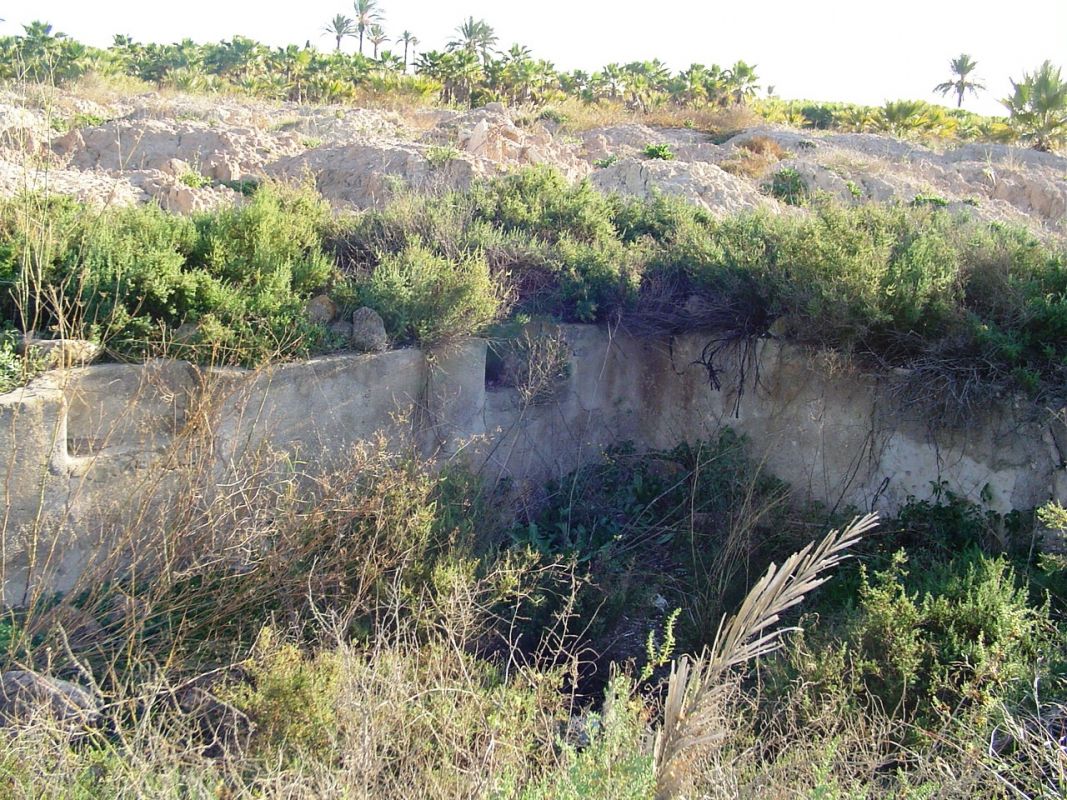
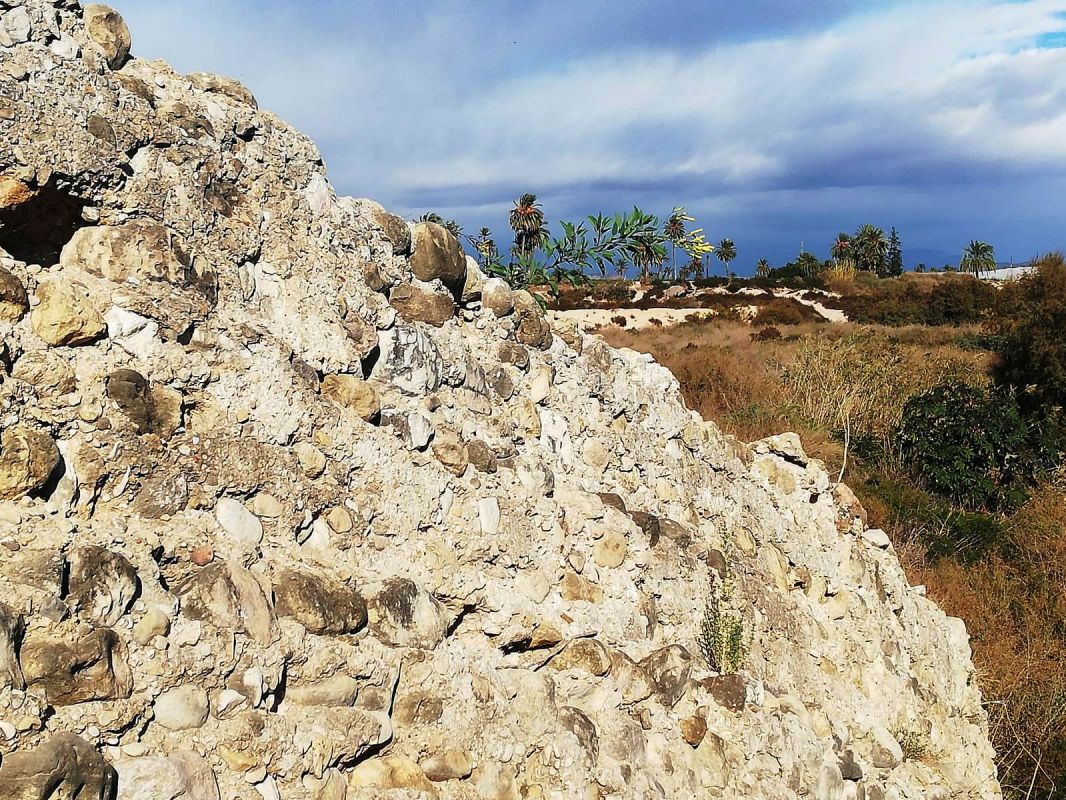
In the Camp d'Elx there are important samples of ethnological heritage, elements, largely unknown by the population and, therefore, neither valued nor protected - de facto - as would be necessary. From constructions, such as the country house itself -with porch at noon and corrals to the north- and, where appropriate, outbuildings (oil mills, wells, reservoirs...), to ditches, azarbes, azudes, tajamares, hemp rafts or furniture... Denominations that barely reflect a sample of the tangible patrimonial wealth (there is also the immaterial...) of the southern departures of the term, populated and transformed -as is known- since ancient times. Let’s see:
Located perpendicularly on the course of the Vinalopó, the azudes known as dels Moros, d'Argamassa and dels Comuns were built in order to take advantage of the flood waters that circulate along the rambla. These are anchovy irrigation, use of the water characteristic of arid and semi-arid zones, which consists in «deriving from the beds of the wadi the flood waters in order to benefit, with it, to properties close to their channels»[1]. These hydraulic infrastructures remain in a lamentable state of conservation, awaiting investigations that shed light on their construction, operation, beneficiaries, etc.
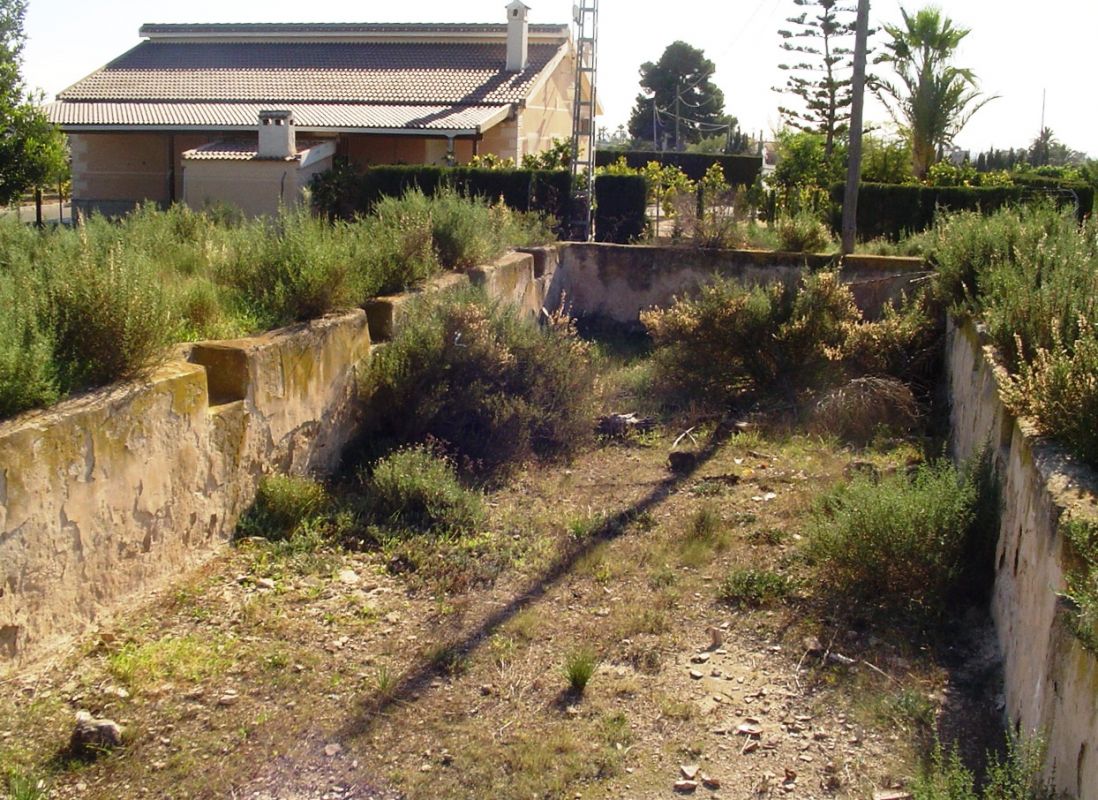
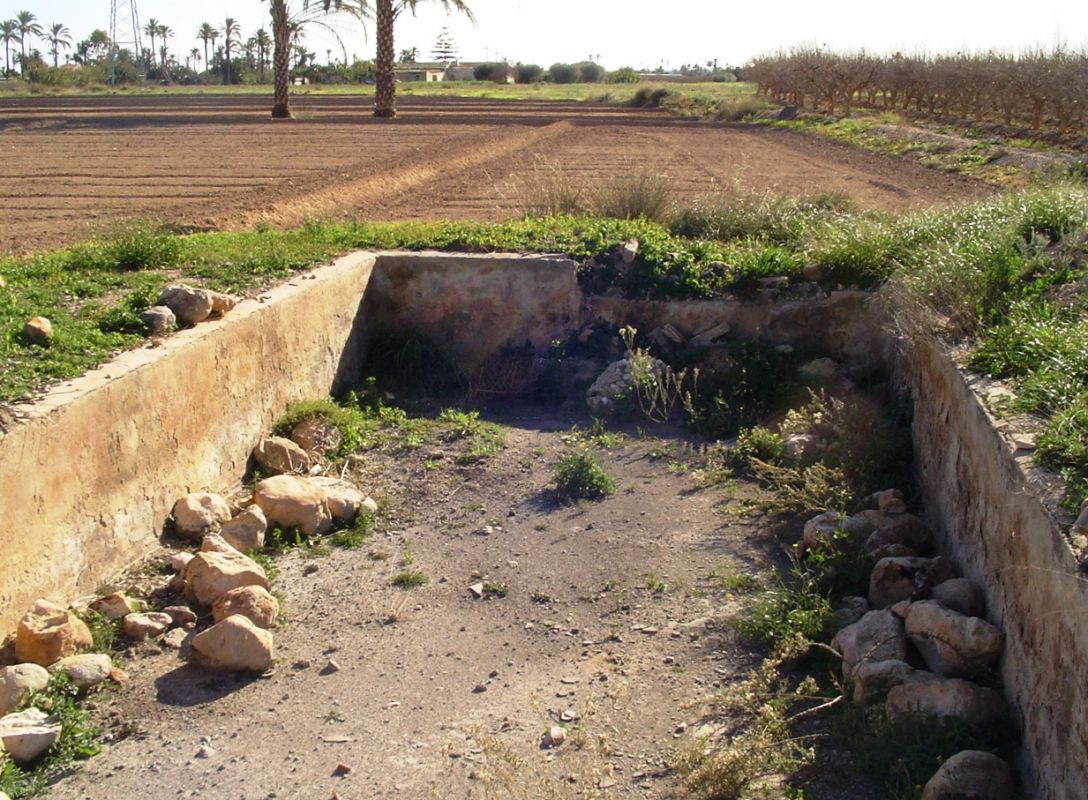
As for the hemp rafts, until a few years ago, at least a small number of them still survived in our term. But what were these rafts for? After mowing and drying, in summer, the hemp bundles were taken to a raft where they were immersed for a variable time until, when softened, the fibers were separated from the stems and hemp, according to the terminology used, was «cooked» or «in its point». It was then removed from the raft (it was «unpacked») and allowed to dry; after a few days, once dry, the agramado took place, which consisted of breaking the beams with the agramadoras, an activity that ended the agricultural processes of this plant[2].
Years ago (2007-2008), integrated into the Wadi Project, in the Department of Marine Sciences and Applied Biology of the University of Alicante, I had the opportunity to inventory a total of eight rafts dispersed by the Camp d'Elx (three in Puçol, two in Asprillas and three others distributed between Algoda, Matola and Alzabares Bajo), figure that, in all likelihood, was below those then existing and that, in any case, should be reviewed at present.
On the other hand, the rural parts of our mountains present some different elements, such as the same architecture of the houses -with the existence also of houses-cave in some points-, walls and other constructions of dry stone, furnaces, azudes, quarries or «water mines», among others that we could mention. A heritage, equally unknown and threatened, given its loss of functionality and its, on the other hand, difficult to fit into the new uses of some sites, used as a space for sports, in which the bicycle is assuming a leading role that has already been reflected in the media[3]. Soon, in addition, it is expected the construction of a campsite called ecological in the district of Santa Ana, territory that, according to the press, «will come out of nowhere» thanks to this business project...
Author: Rafa Martínez, director of the Pusol Project.
[1]Morales Gil, A. and Box Amorós, M. (1986): «The use of water and soils in a semi-arid domain: the basin of the Barranco Blanco, Agost (Alicante)». Geographical Research, No 4, p.7.
[2]The hemp works can be observed every year in Callosa de Segura and Redován, municipalities that, on the occasion of their patron saint festivities, in August and September respectively, organize exhibitions on those, starring, above all, by former workers. For the process of obtaining hemp fibre, see: Albert Lucas, R. F. (1989): The hemp industry in Callosa de Segura (Alicante). Cataloguing and study of tools and other products derived from this craft industry. Alicante, Instituto de Cultura «Juan Gil-Albert», Diputación Provincial de Alicante, p. 40-65, mainly.
[3] In the summer of 2019, two thousand cyclists protested in front of the City Council expressing their disagreement with the sanctions imposed by the SEPRONA, when circulating through forest lands of the municipality. Two thousand... (<www.elche.es> [Enquiry: 02/02/2021]).